

Guest post by: Marybeth Beattie and Mary Alpaugh, English Faculty
The community college system is part of a narrative sustained by big data. We use algorithms to track student placement and graduation rates, evaluate program models, and secure funding opportunities. Data is useful in giving us a snapshot of student skill levels and their past academic experiences, but it gives us very little information about what students need to be successful. It does not disclose their passions, interests, and aptitudes that would guide their pathways to success, nor does it reveal the intricacies of their everyday lives. There is no spotlight on the pride they feel for their families, the house that they made a home, their proficiency in language other than English. It does not celebrate their culture, their religion, or their traditions.
Many factors that contribute to academic success that cannot be measured and quantified. In the article, Rethinking Data: How to Create a Holistic View of Students profiled, Denver teacher Kyle Schwartz. Schwartz asked her students to complete this sentence in writing: “I wish my teacher knew . . . ” Student responses were as follows:
- “I wish my teacher knew how much I miss my Dad because he got deported to Mexico when I was 3 years old and I haven’t seen him in 6 years.”
- “I wish my teacher knew that I’ve been having trouble balancing my homework and sports lately.”
- “I wish my teacher knew I don’t have pencils at home.”
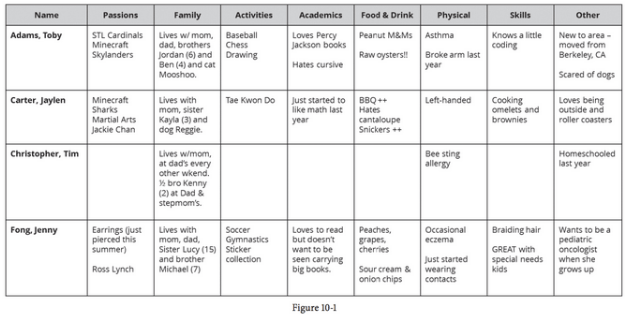
For the past ten years, educational institutions have been collecting quantitative data that helps educators assess student placement and abilities and create curriculum to meet the students’ needs. However, statistics do not cover all aspects of a student’s environment and learning capabilities. The article “Rethinking Data: How to Create a Holistic View of Students” suggests that teachers need to understand the totality of a student rather than only the information that can be quantified. One method for doing this suggested in the article is a 360 Spreadsheet (Figure 10-1) in which teachers can note the students’ passions, family life, activities, and other aspects of their personal lives.
Teachers can use this knowledge however works best in their classrooms. Lisa Tremonte, a special education teacher from New Jersey, created her spreadsheet and found that her students lit up when she asked them about their hobbies or families. “They know that I listen to them, care about them, and think their lives are important” she commented (“Rethinking Data”). No quick fix exists to resolve the challenging issues that educators face. However, building connections with students outside of only academics can foster mutual respect between teachers and students and encourage student engagement. Students can recognize that their education is a piece of the larger whole of their lives, not an obstacle to overcome.
Sample 360 Spreadsheet

References
“Rethinking Data: How to Create a Holistic View of Students.” MindShift, KQED Inc., 25 Aug. 2015, http://www2.kqed.org/mindshift/2015/08/26/rethinking-data-how-to-create-a-holistic-view-of-students/. Accessed 28 Aug. 2017.